Crust
Alessandro
Crust
Crust
Alessandro
Crust
Born in 1847 as Thomas Alva Edison, and Galileo Ferraris, with whom his story will intertwine.
What prompted me to delve deeper into this character is the fact that he is practically unknown to most, even though he was the one who brought about an epochal turning point in the invention of the century: the light bulb! From humble origins, he dedicated himself to the study of chemistry and physics, which led him to research a method for creating artificial diamonds. As often happens, each man tries to tackle the problems before him by drawing on his own expertise. His studies, his passion for diamonds, were the fundamental piece that drove him to become the world's leading producer of electric light bulbs, beating Thomas Alva Edison to the punch!
Who really invented the light bulb?
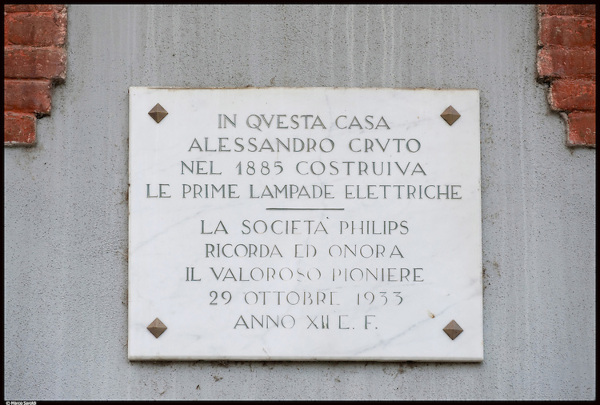
For this question, there seem to be a thousand answers, and the most popular one appears to be ”Edison.” But if this is the only answer we can come up with, then we can rest assured: the wheel and hot water are two inventions of Edison! If, however, we want to try to move beyond ’common sentiment‘ and analyze the facts, we can say that Edison did not invent the light bulb, nor did Cruto. However, the latter turned an idea into reality, and if Philips itself decided to place a plaque to honor the first light bulb manufacturer... we must ask ourselves a question and analyze the objective facts!
It was 1802 (45 years before Edison was born) when Humphry Davy demonstrated the operation of an arc lamp, which was nothing more than an electric lamp that produced light by harnessing the voltaic arc (in direct current, of course) generated between two carbon electrodes. This was indeed an electric lamp that was widely used for public lighting. Therefore, if we really want to assign paternity to the idea, this Englishman was the one who thought of electrical energy as a source of light. Everything that came after was merely an evolution of this idea.
In 1835, James Bowman Lindsay succeeded in creating the first incandescent lamp, which no longer emitted light through an ‘electric arc’ but by heating an electrode. In 1841 (Edison was not yet born), electric lamps were installed for public lighting in Paris.
In 1872, Russian Alexander Lodygin (1847-1923) invented an incandescent light bulb and, for this, obtained a Russian patent in 1874. Later moving to the United States, he changed his name to Alexander de Lodyguine, obtaining patents for incandescent lamps that used filaments made of chromium, iridium, rhodium, ruthenium, osmium, molybdenum (which was demonstrated in 1900 at the Paris World's Fair), and tungsten. This latter material is still found in filament light bulbs today.
In 1875, a new patent for the electric light bulb was registered in the name of Henry Woodward, but the patent was limited to the United States. It was precisely this patent number US181613A which was sold to Edison who expanded it worldwide.
Edison's patent was then the US223898A registered on 01-27-1880 and I believe this is what history (inexplicably) refers to. However, Edison didn't have a working light bulb; he patented an idea, an intention, an improvement on previous light bulbs that, in fact, he didn't have. Edison possessed many qualities. The first was certainly having a lot of money and many influential friends. The second was being extremely skilled at exploiting legal rights (he registered over a thousand patents, many, very many, controversial!). .
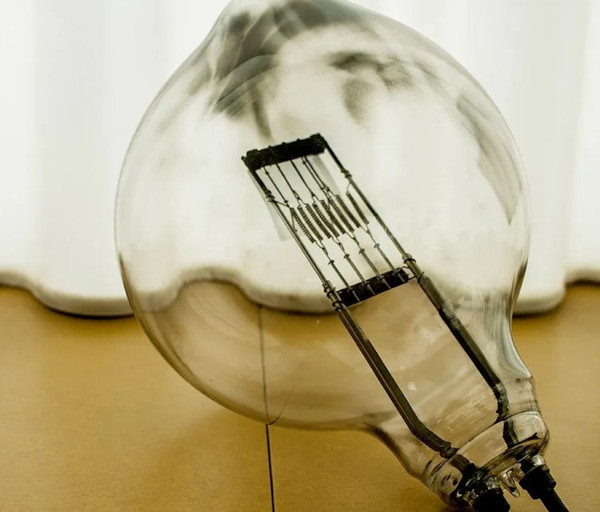
In 1879, Alessandro Cruto was working on using his expertise in the creation of synthetic diamonds to produce a new type of filament, which he succeeded in creating on March 5, 1980. It was a filament onto which an extremely thin layer of carbon was crystallized; in this way, Cruto obtained a filament whose electrical resistance increased as the temperature rose. In practice, graphite was made to crystallize onto an extremely thin platinum wire to a thickness of a few hundredths of a millimeter. The platinum was then melted away, leaving the crystallized carbon in the form of an extremely thin hollow tube. This crucial ‘detail’—which made Cruto’s filament the first positive-coefficient filament—ensured that, once a certain temperature was reached, the current automatically decreased, thereby stabilizing the temperature and preventing the filament from melting. All other experimenters, including Edison, ended up burning out their filaments precisely because, as the temperature rose, the electrical resistance decreased and, consequently, the current increased steadily until the filament was destroyed. It was precisely during these years that Maxwell published—and thus brought to the public’s attention—the work of Georg Ohm, whose law relating current to resistance and voltage would certainly have been of great help to researchers of the time.
In practice, Cruto’s light bulbs emitted white light for 500 hours and were economically viable and ready for mass production, while Edison’s prototypes lasted barely 40 hours, emitted a yellowish light, and could not be mass-produced.
As things stood, while Edison had registered a worldwide patent for an idea that wasn’t his own and was busy trying to make it work by systematically and painstakingly experimenting with every kind of material (charred cotton, bamboo, etc.) to arrive at a marketable ‘product,’ Alessandro Cruto had, in fact, solved the problem but did not have enough money to register a worldwide patent. To put it even more succinctly, Cruto had the light bulb… Edison did not!
History records that on May 16, 1883, Piossasco (Cruto’s birthplace) —a town not far from Turin—was the first Italian city to be lit by electric light bulbs, followed by Alpignano, where his light bulb factory was located, and Turin. While in the rest of the world, inefficient gas or electric arc lamps illuminated the streets with a dim yellow light… in Italy, efficient light bulbs emitting a bright white light were being installed. It was a huge success, and thus began the production and marketing of electric light bulbs, which went on to illuminate cities all over the world.
Alessandro Cruto founded the world's first light bulb factory in Piossasco, which he later moved to Alpignano. on the banks of the Dora (today a museum) and, a short distance away, he built a small power plant harnessing the river's power to supply and test them. The meager finances and, therefore, the inevitable presence of partners, severely undermined the stability of that venture, and Cruto had to cede the light bulb factory to his partners, which was subsequently sold first to Edison and then to Philips. Having moved to Turin, he died in his home at Corso Vittorio Emanuele 32 in 1908, where Philips made affix a plaque in his memory and honor.