TECHNICAL ARCHIVE · VALVE SOCKETS
← Find a valve socketNoval (B9A)
Mechanical data, images and references from the EnryLab archive.
Key specifications
- Reference code
- B9A
- Contact positions
- 9
Mechanical dimensions
All linear dimensions are in millimetres and describe the valve base and its pins. They are not socket-hole diameters.
The pin circle passes through the pin centres. Pin spacing is the straight-line distance between adjacent centres. ≈ denotes a value calculated from nominal geometry; ± denotes a tolerance, parentheses show limits and ≤ denotes a maximum.
| Dimension | Value (mm) | Detail |
|---|---|---|
| Valve base · Dimension set 1 | ||
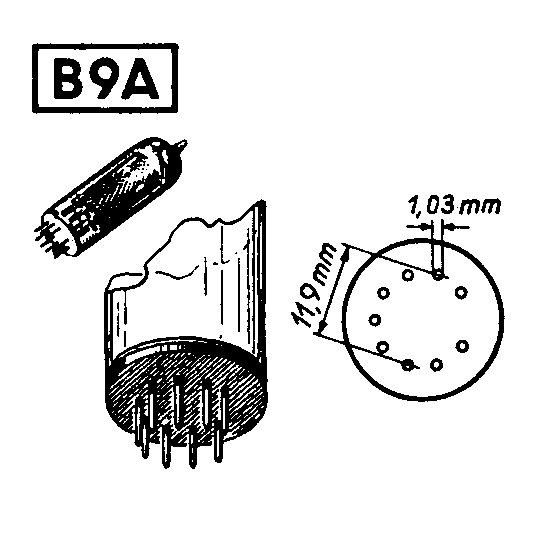
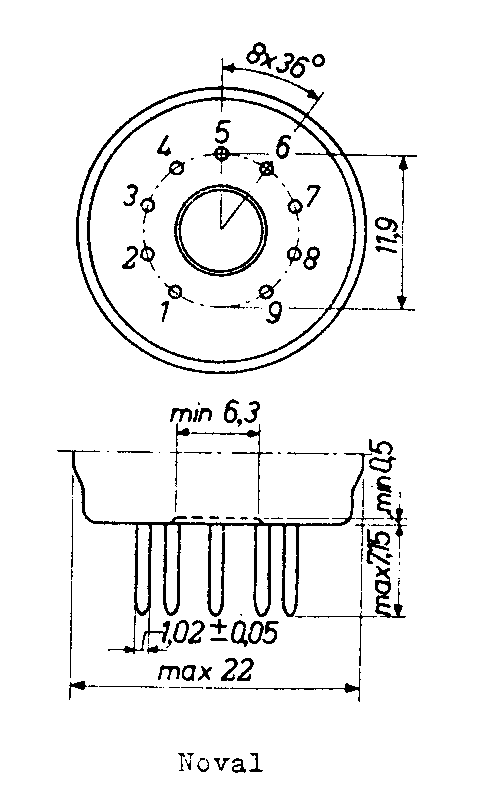
| Diameter of the pin-centre circle | 11.9 | Dimension shown in the drawingView detail |
| Adjacent pin spacing (regular pitch) | ≈ 3.677 | Calculated valueView detail |
| Pin diameter | 1.02 ± 0.05 | Dimension shown in the drawingView detail |
| Pin length | ≤ 7.15 | Dimension shown in the drawingView detail |
| Base-body diameter | ≤ 22 | Dimension shown in the drawingView detail |
| Valve base · Dimension set 2 | ||
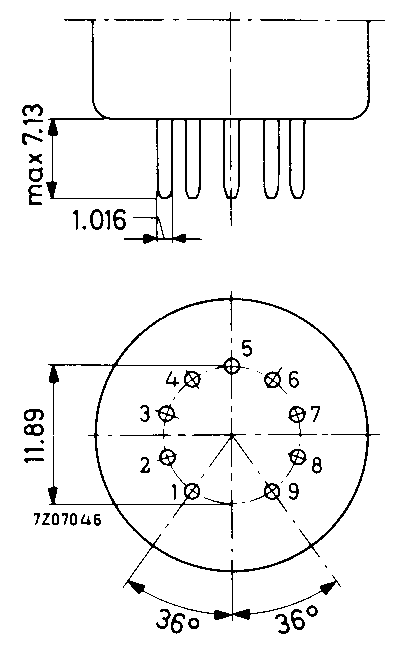
| Diameter of the pin-centre circle | 11.89 | Dimension shown in the drawingView detail |
| Pin diameter | 1.016 | Dimension shown in the drawingView detail |
| Pin length | ≤ 7.13 | Dimension shown in the drawingView detail |
In depth
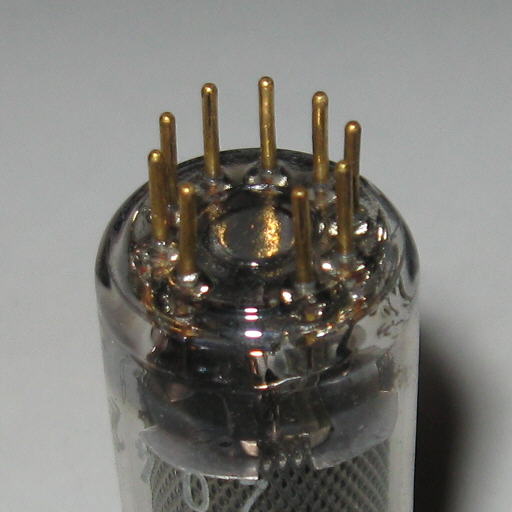
The Noval B9A is the nine-pin base used by many all-glass valves from the period after the Second World War. Examples in this family include the ECC81, ECC82, ECC83, EL84 and EZ81: valves with different functions that share the same mechanical interface. It is therefore a useful family to recognise both in loose valves and in receiver and amplifier chassis; the base designation alone, however, identifies neither the valve nor its electrical connections.
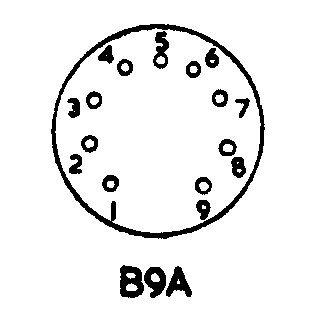
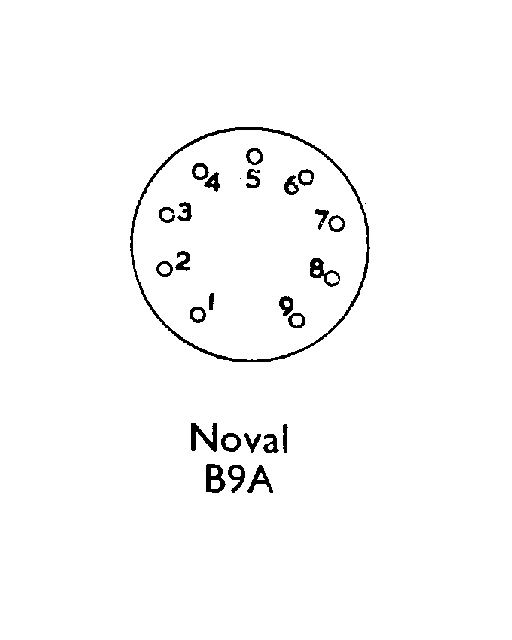
The pins are arranged on a circle with a regular angular pitch of 36 degrees. The nine positions leave a wider gap between the first and ninth pins: this gap provides the insertion reference without a central locating spigot. The family drawings show the valve base viewed from below. When comparing them with a valveholder, the viewing direction must be respected, because changing to a top view reverses the apparent order of the terminals.
The reference mechanical drawing specifies a pin-circle diameter of 11.9 mm and pins of 1.02 ±0.05 mm, giving limits of 0.97 to 1.07 mm. The nominal geometry gives a centre-to-centre spacing of approximately 3.677 mm between two regularly spaced adjacent positions. This spacing is the straight-line distance between the centres, not the circle diameter or the distance across the wider gap. The same drawing specifies a maximum pin projection of 7.15 mm.
Another illustrated version has a pin circle of 11.89 mm, pins of 1.016 mm and a maximum projection of 7.13 mm. Each set of dimensions remains specific to its own construction: differences in rounding do not establish additional tolerances. The 22 mm limit for the overall size of the base is also distinct from the diameter of the contact circle.
From the 1950s, the B9A became a widely used base for all-glass valves, often with tubular envelopes approximately 20 mm in diameter. In 1953, Mullard presented the ECH81 while emphasising the military services’ preference for this base. This was a commercial statement about that particular product, not a military qualification applicable to every Noval valve.
Similar names and a common nine-pin count do not make Noval, Novar and Magnoval interchangeable. Nine-contact constructions with central retention are also distinct, as is the E10-73 interface, which adds a central contact to the nine peripheral contacts. Recognising a B9A requires comparison of the layout, orientation and dimensions; replacing a valve also requires the pin connections, voltages and electrical characteristics of the particular type.
Technical drawings
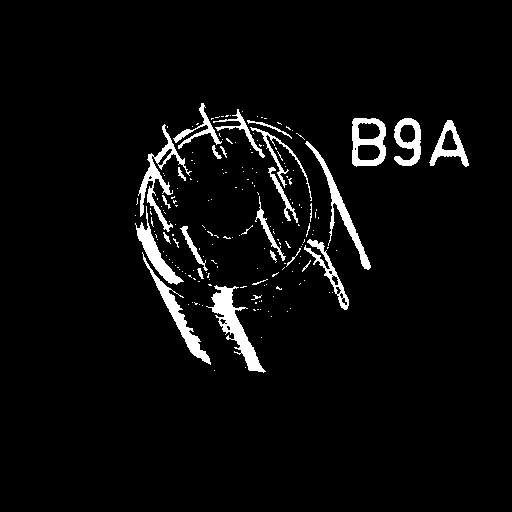
The drawings show orientation and geometry. Links beside the dimensions open the available detail.
Photos and examples
Related valves in the archive
Total linked designations: 2,653